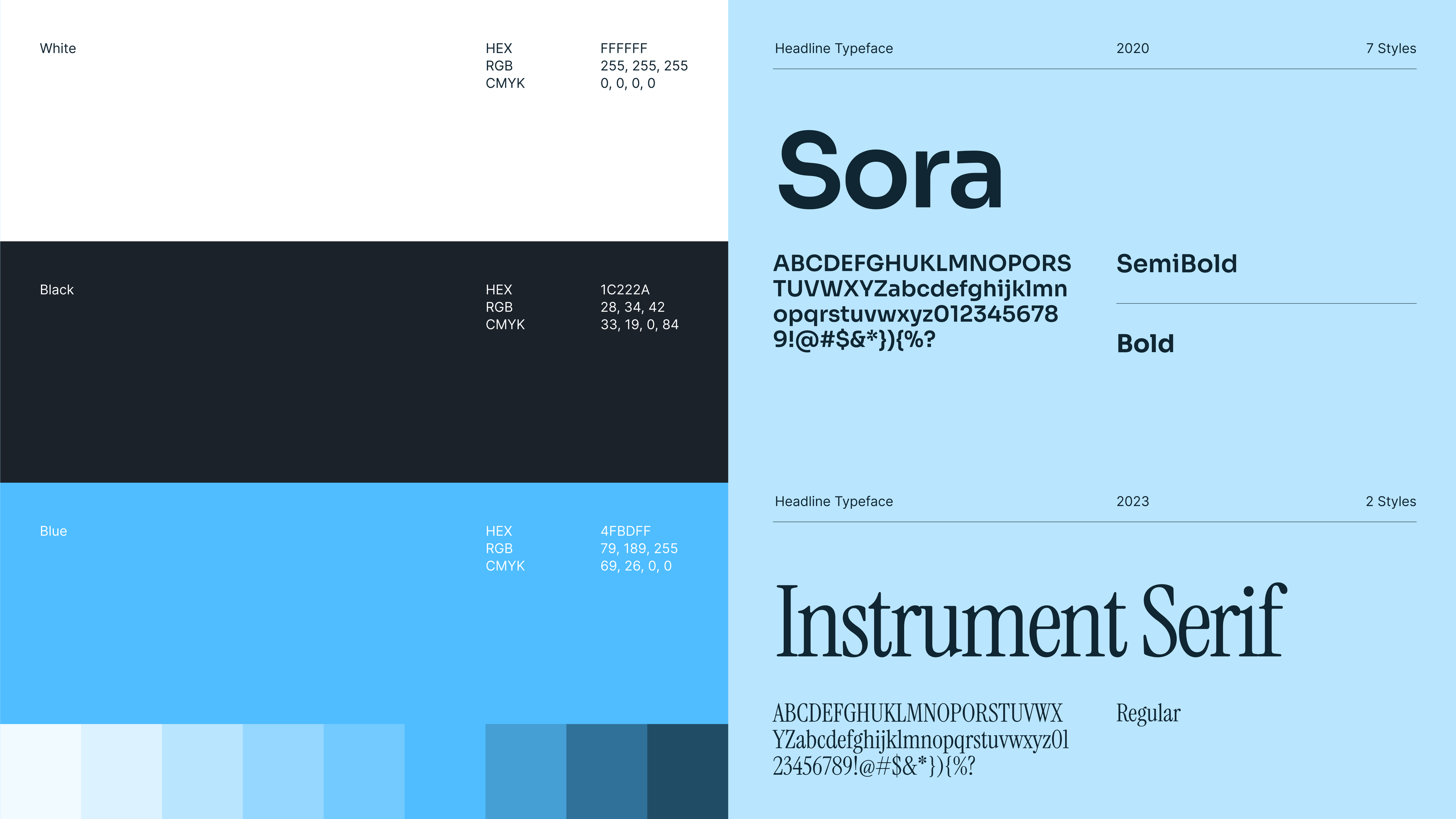
As companies grow, complexity doesn’t just increase in their products. It spreads across teams, tools, communication, and decision-making. Marketing struggles to maintain consistency across campaigns. Product teams redesign components repeatedly. New hires interpret the brand differently from those who built it. Over time, the organization begins to feel fragmented.
At this stage, two terms start appearing in discussions: brandbook and design system.
They are often used interchangeably. Some leaders assume they are variations of the same concept. Others believe one can replace the other. Teams sometimes invest heavily in one while ignoring the other entirely, only to discover later that the missing piece was solving a different problem altogether.
Understanding the distinction between a brandbook and a design system is not a semantic exercise. It is a strategic decision that determines how a company scales its identity, product experience, and internal efficiency.
Why These Two Concepts Are Confused
Both brandbooks and design systems aim to create consistency.
Both define rules.
Both document decisions.
Both guide teams toward alignment.
From a distance, they look similar.
The confusion arises because they operate at different layers of the organization. A brandbook defines how a company should be perceived. A design system defines how interfaces should be built. One shapes identity. The other shapes execution.
When teams lack clarity about these layers, they attempt to use one tool to solve problems belonging to the other. This mismatch leads to frustration. Marketing complains about inconsistent visuals despite having a design system. Product teams struggle with UI chaos despite having a brandbook.
Neither tool is broken.
They are simply being applied to the wrong problem.
What a Brandbook Actually Solves
A brandbook establishes the foundation of a company’s identity. It answers questions about tone, personality, visual language, messaging style, and overall positioning. Its purpose is to ensure that every external touchpoint feels like it comes from the same organization.
Without a brandbook, communication drifts. Different teams produce materials that look unrelated. Messaging becomes inconsistent. Visual elements vary depending on who created them. The company starts to feel less like a coherent entity and more like a collection of departments.
A well-constructed brandbook creates alignment across marketing, sales, partnerships, recruiting, and public presence. It ensures that advertisements, social media, presentations, and websites reinforce the same perception.
However, a brandbook does not dictate how product interfaces should be built in detail. It rarely addresses component behavior, interaction patterns, or technical implementation. Its scope is strategic rather than operational.
What a Design System Actually Solves
A design system focuses on building products efficiently and consistently. It defines reusable components, layout structures, spacing rules, interaction patterns, accessibility guidelines, and implementation details. Its primary audience is product designers and engineers.
Without a design system, teams reinvent solutions repeatedly. Buttons behave differently across screens. Spacing becomes inconsistent. Development time increases because each new feature requires building UI elements from scratch. Maintenance becomes expensive as variations multiply.
A mature design system accelerates development while improving quality. Teams can assemble interfaces from reliable components instead of designing everything anew. This reduces errors, simplifies onboarding for new team members, and ensures that the product experience feels coherent even as it expands.
Unlike a brandbook, a design system lives inside the product. Its impact is operational, not primarily perceptual.
Internal vs External Consistency
One useful way to distinguish the two is by considering where consistency matters most.
A brandbook protects external consistency. It ensures that customers, partners, and the public encounter a recognizable identity regardless of the channel.
A design system protects internal consistency. It ensures that the product behaves predictably and that teams build interfaces in a unified way.
Both forms of consistency influence trust, but they operate on different levels. External consistency shapes expectations before interaction. Internal consistency shapes experience during interaction.
Neglecting either can damage credibility.
Strategic Identity vs Operational Execution
Brandbooks answer strategic questions such as who the company is, what it stands for, and how it wants to be perceived. They guide decisions about messaging, positioning, and visual direction at a high level.
Design systems answer operational questions such as how buttons should behave, how forms should be structured, and how layouts adapt across devices. They guide daily production work.
Confusing these roles leads to inefficiency. Expecting a brandbook to solve engineering workflow issues is unrealistic. Expecting a design system to define brand personality is equally misguided.
Organizations need both strategic direction and operational infrastructure.
When You Need One Without the Other
Early-stage startups often benefit from a brandbook before investing in a full design system. At that stage, the priority is establishing identity and differentiation rather than optimizing large-scale production.
Conversely, companies with stable branding but rapidly expanding products may need a design system even if their brand guidelines are already mature. Their challenge is managing complexity, not defining identity.
Understanding the primary bottleneck prevents overbuilding solutions that do not address immediate needs.
When You Need Both
As companies scale, the distinction becomes less optional.
Marketing expands into new channels. Product teams grow. Multiple designers and engineers contribute simultaneously. International markets introduce additional complexity. Partnerships require shared assets.
At this point, lacking either a brandbook or a design system creates friction.
Without a brandbook, external communication fragments. Without a design system, internal production slows and quality declines.
Together, they create alignment across the entire organization, from perception to execution.
The Cost of Choosing Wrong
Investing heavily in one while ignoring the other can produce misleading results.
A company with a strong brandbook but no design system may look polished externally while struggling internally with slow development and inconsistent interfaces. Conversely, a company with a robust design system but weak branding may ship efficiently yet fail to differentiate in the market.
Both scenarios limit growth.
Efficiency without identity leads to commoditization.
Identity without efficiency leads to operational strain.
Balanced organizations avoid both extremes.
How Mature Companies Use Them Together
Highly effective organizations treat brandbooks and design systems as complementary assets rather than competing priorities.
The brandbook defines the destination.
The design system provides the vehicle.
One ensures that the company knows who it is. The other ensures that teams can express that identity consistently at scale.
When aligned, they reinforce each other. Brand principles inform component aesthetics and tone. Product experiences reinforce brand perception through consistent interactions.
Users may never see either document.
But they feel the results.
Final Thoughts
Brandbooks and design systems solve fundamentally different problems, yet both are essential for companies that intend to grow without losing coherence.
A brandbook aligns perception.
A design system aligns production.
Confusing them leads to frustration because each addresses a separate dimension of organizational complexity. Recognizing their roles allows leaders to invest strategically rather than reactively.
In the long run, companies that manage both identity and execution effectively build experiences that feel intentional, reliable, and scalable.
And those qualities are difficult to replicate once lost.