Most startups don’t intentionally ignore branding.
They simply assume it can wait.
In the early stages of a company, everything feels urgent and practical. Shipping features matters. Fixing bugs matters. Talking to customers matters. Compared to those pressures, creating a brandbook feels abstract, almost decorative, like something you polish later once the “real work” is done.
So it gets postponed.
Weeks turn into months. The product grows. New pages are added. Marketing starts publishing. Designers move fast. Freelancers join temporarily. Different people make decisions under time pressure.
Nothing looks obviously wrong.
But nothing feels completely right either.
The website becomes slightly inconsistent. Social posts look unrelated to the product. Sales decks feel like they belong to another company. New UI screens don’t quite match the old ones. Every design decision takes longer than it should because there is no shared reference for what “on-brand” actually means.
At some point, someone finally says, “We need a brandbook.”
By then, the problem isn’t branding anymore.
It’s operational chaos.
And fixing chaos is always more expensive than preventing it.
A brandbook is not a cosmetic deliverable. It is not a PDF you create for investors. And it is definitely not just a logo and a color palette.
At its core, a brandbook is a decision system. It’s what allows a company to move faster, stay consistent, and scale without losing coherence.
That’s what most startups misunderstand. And that’s why they build it too late.
The Misconception Around Brandbooks
If you ask most founders what a brandbook is, they’ll usually describe it as something visual. A document that defines the logo, the fonts, maybe a few colors and some design examples.
In other words, something aesthetic.
This framing is exactly why brandbooks get deprioritized. Aesthetic improvements feel optional when you’re trying to survive.
But the truth is that branding is far less about visuals than people think. The visuals are just the surface layer. Underneath, a brandbook exists to remove friction from everyday work.
Without a clear system, every small decision becomes a discussion.
Which font should we use here?
Is this headline tone correct?
Should this page feel playful or serious?
Does this look like us?
Individually, these questions are minor. Collectively, they drain time and create inconsistency.
Multiply that by dozens of decisions every week, across multiple team members, and suddenly branding isn’t a design problem anymore. It’s a productivity problem.
A brandbook solves that.
Not by making things prettier, but by making decisions predictable.
What a Brandbook Actually Is
A more accurate way to describe a brandbook is this:
It’s a shared rulebook for how your company presents itself.
It defines how you look, how you speak, and how you behave across every touchpoint so individuals don’t have to improvise every time they create something.
When those rules exist, designers don’t guess. Marketers don’t interpret. Freelancers don’t invent their own style. Everyone works within the same boundaries.
This is incredibly powerful.
Because growth introduces variability. The more people you add to a team, the more opinions you add. And opinions, when unchecked, lead to fragmentation.
Systems are what prevent that fragmentation.
Mature companies understand this intuitively. That’s why they treat branding like infrastructure, not decoration. It’s closer to engineering than art direction.
Once the system exists, everything else becomes faster.
What Breaks Without One
The absence of a brandbook rarely causes dramatic failure. Instead, it creates slow, invisible damage that compounds over time.
Marketing creates assets that feel slightly different from the product. Sales materials look outdated. New features introduce UI patterns that don’t match existing ones. Social content feels disconnected from the website.
Nothing is obviously wrong.
But everything feels a bit off.
Users notice this subconsciously. Even if they can’t articulate it, inconsistency reduces perceived trust. If a brand feels scattered, it feels less reliable.
And reliability is exactly what customers look for before they commit money or time.
Internally, the damage is even more obvious. Design cycles get longer. Teams debate basics repeatedly. New hires struggle to understand expectations. External partners require constant revisions.
Ironically, the time saved by “skipping branding for now” ends up being lost many times over.
The Real Functions of a Brandbook
When you strip away the surface, a brandbook performs several practical functions that directly impact business performance.
First, it creates consistency. Consistency builds recognition, and recognition builds trust. When every touchpoint feels related, users develop confidence in the brand.
Second, it speeds up execution. Designers and marketers stop reinventing fundamentals and start focusing on meaningful problems.
Third, it aligns teams. Everyone shares the same visual and verbal language, which reduces misunderstandings across departments.
Fourth, it improves perceived professionalism. Structured brands feel established. Inconsistent brands feel temporary.
Finally, it enables scale. As the company grows, quality stays stable because the system carries the brand, not individual taste.
These benefits are operational, not aesthetic. They affect how fast you ship, how clearly you communicate, and how trustworthy you appear.
Why Consistency Directly Impacts Trust
Trust is often discussed in abstract terms, but it’s heavily influenced by small visual and behavioral signals.
When spacing is inconsistent, typography changes randomly, or tone shifts between pages, users feel uncertainty. They might not consciously notice the cause, but they feel friction.
And friction slows decisions.
Slower decisions reduce conversions.
It’s that simple.
A consistent system removes that friction. It makes experiences predictable. Predictability feels safe. And safety is what drives people to buy, subscribe, or contact you.
Consistency isn’t just polish.
It’s psychology.
Startup vs Systemized Brand Comparison
This difference often determines whether a company looks like a side project or a serious business.
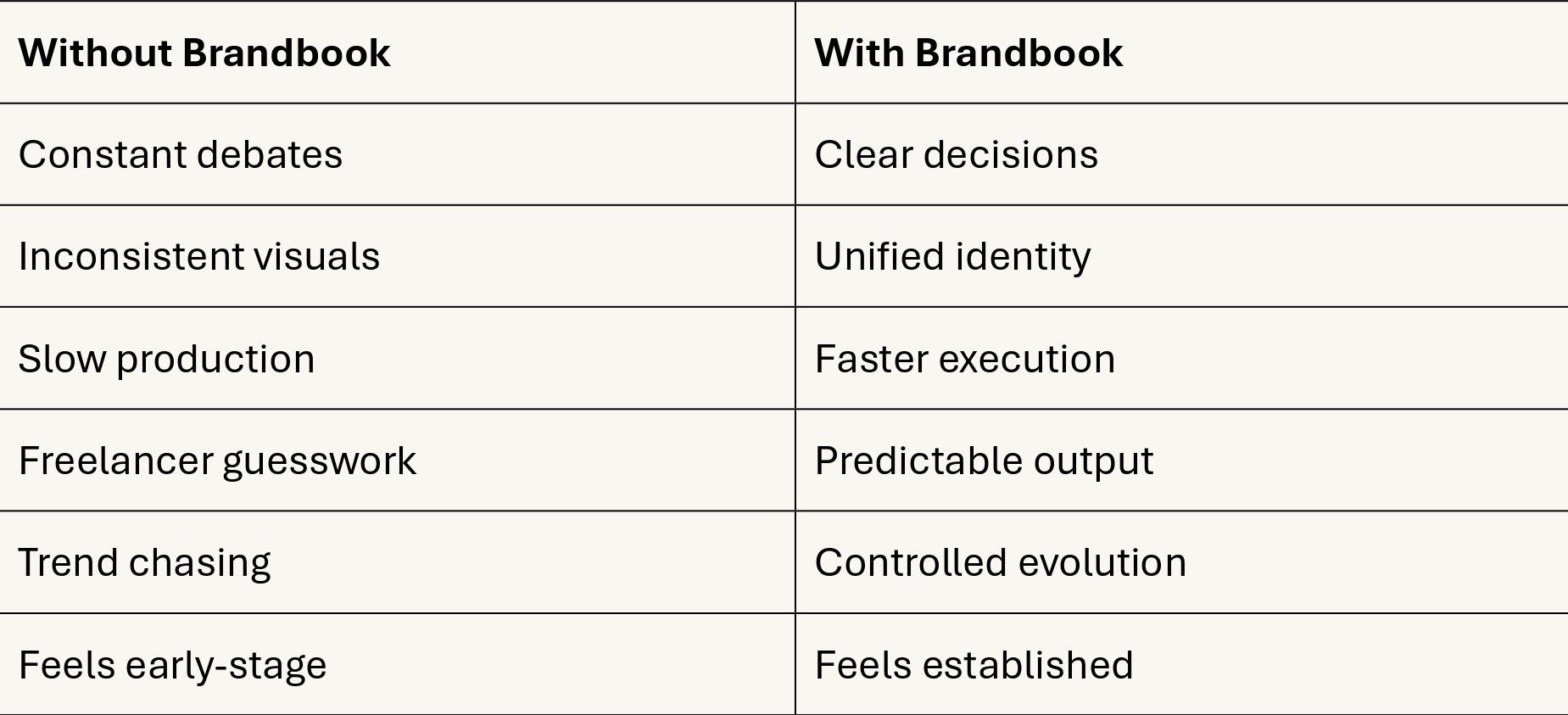
And serious businesses attract better clients.
What a Modern Brandbook Should Include
Modern brandbooks don’t need to be massive documents nobody reads. They need to be practical tools people actually use.
At minimum, they should define:
A visual system, including typography, colors, layout rules, and components.
A verbal system, including tone of voice and messaging principles.
A behavioral system, including motion and interaction guidelines.
Because a brand is not just how it looks.
It’s how it behaves.
When all three layers align, the brand feels intentional rather than accidental.
How to Build One Without Slowing Down
Many startups avoid brand work because they fear it will delay progress. In reality, you don’t need perfection to start.
You just need clarity.
Begin with a small set of rules. Two typefaces. A simple color system. Clear spacing logic. A defined tone of voice. Expand gradually as the company grows.
Think of your brandbook as a living system, not a one-time project.
It evolves with you.
But the earlier you establish it, the less chaos you’ll need to clean up later.
Final Thoughts
A brandbook isn’t something you create when you want to look professional.
It’s something you create so you can operate professionally.
Without it, every decision adds friction. With it, execution becomes faster, more consistent, and more reliable.
Startups often treat branding as something you earn after growth.
In reality, branding is what makes sustainable growth possible in the first place.
Consistency is not decoration.
It’s leverage.
And leverage is what serious companies build on.